Wet wall, soaked carpet or a spreading stain? That is a mitigation job
Water in the walls or under the carpet is an emergency, so call the 24/7 line, shut off the source at the main valve and lift valuables off wet floors while the crew is on the way. The trade name for what happens next is water mitigation, the work done in the first 24 to 72 hours to stop damage from growing. It comes before repair and before any rebuilding.
The ANSI/IICRC S500 standard is the published industry reference for structural drying. It ties drying goals to moisture readings instead of a fixed number of days, which is why readings are logged at each visit.
What water mitigation includes
Water mitigation limits the damage a water loss can cause. In practice it is a short list of tasks done in order, and skipping one usually costs more later.
- Stop the source, whether that is a pipe, a fixture or an appliance.
- Extract standing water with pumps and extraction units.
- Map the moisture with meters and a thermal imaging camera, wall by wall.
- Remove materials that cannot be dried, such as saturated pad or soft insulation.
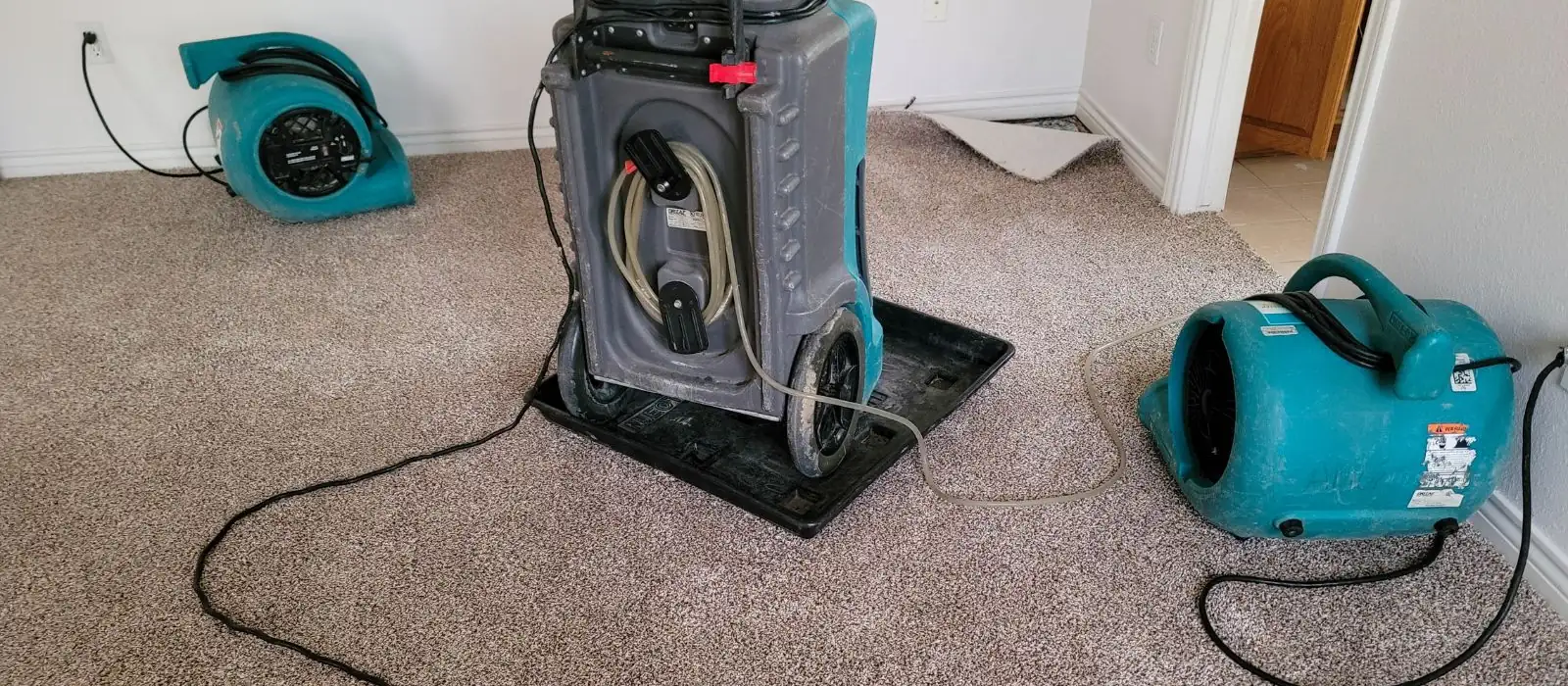
- Place air movers and dehumidifiers based on the readings.
- Check and record moisture daily until the structure matches dry reference readings.
Compare this with emergency water removal, which focuses on pulling out the standing water, and with water damage repair, which rebuilds afterward. Mitigation is the bridge between them.
Structural drying: how air movers and dehumidifiers work
Structural drying is the part of mitigation that moves moisture out of building materials. Air movers push dry air across wet surfaces so water evaporates. A dehumidifier then pulls that moisture out of the air, so it does not settle back into the walls. The two only work well together in a closed space.
Low grain refrigerant dehumidifiers, called LGR units, are common for drying houses because they keep working when the air is already fairly dry. Wall cavities are dried with small openings or by lifting baseboards, and floors can be dried with panels that pull air through the material.
Crews do not stop when the surface feels dry. They compare readings on the wet materials with readings on similar unaffected materials in the same house, and drying is done when the two match. A moisture meter and a thermal imaging camera give that answer, while touch does not.
| Stage | What happens | How you know it is working |
|---|---|---|
| First hours | Source stopped, water extracted, moisture mapped, equipment placed | Standing water gone and a written map of wet areas |
| Day 1 to 2 | Wet porous materials removed, equipment adjusted | Readings dropping in the wettest materials |
| Day 2 to 4 | Daily monitoring, equipment moved to stubborn spots | Readings approaching dry reference levels |
| Final check | Meters confirm dry readings, equipment removed | Written drying record you can give to your insurer |
Documentation for your insurance claim
Insurers want evidence of what happened and what was done. A mitigation crew should leave you with dated photos, a moisture map, daily readings and a written scope. Keep your own photos too, taken before anything is moved, and save receipts for any emergency purchases.
Sudden and accidental water damage is often covered by homeowners and renters policies, and gradual leaks and neglect often are not. Flood is usually excluded. Check your policy or ask your insurer, because we cannot say what yours will pay. The California Department of Insurance hotline is 1-800-927-4357 if you need help with a dispute.
South Gate details that change the first hour
Valves, utilities and older homes in South Gate
The City of South Gate's water comes from local deep groundwater wells, and its 2021 water quality report lists total hardness of 226.3 mg/L. Mineral scale can stiffen old shutoff valves, so test yours before a leak. The City's water operations contact in that report is (323) 563-5796.
Some South Gate and Hollydale addresses are served by Golden State Water, which lists its customer service line as open 24 hours at 1-800-999-4033. Check your water bill for your provider's name so you know which number to call.
A large share of South Gate's housing was built between about 1910 and 1940. If your home is from that era, tell the crew, because older wall materials and paint can change how drying openings are made and how debris is handled.
What changes the cost of mitigation
- Water category and how long the water sat before the first call
- Square footage and number of rooms affected
- Materials, since hardwood, plaster and carpet dry at different speeds
- Number of drying days and pieces of equipment placed
- Whether wall cavities or subfloors must be opened
The crew explains scope and price before work starts. For your own, call (213) 776-0579. Mitigation in a neighboring town works the same way, and you can read the local details for Huntington Park and Paramount on their pages.
What to do before the crew arrives
The first hour matters. Do not enter a room with standing water if the power may be on, and do not use household vacuums on wet floors.
- Stop the source by closing the shutoff valve.
- Turn off power to wet rooms at the breaker if you can reach it dry.
- Lift small items, rugs and cushions off wet surfaces.
- Photograph the damage and call (213) 776-0579 to describe what you see.
Water mitigation questions
Yes. After-hours and weekend calls are answered like any other, so a leak at 2 a.m. gets the same intake questions and the same dispatch process. Crews head out as soon as one is available, and same-day response is offered whenever crews can be spared.
Many jobs take a few days, and thick materials like hardwood and plaster take longer. The crew checks readings daily and removes equipment only when meters show dry readings.
Rental units can move air, but without a moisture meter and a plan it is hard to tell when walls are really dry. Crews place equipment based on readings and check it daily. Call and describe your situation, and the dispatcher can talk it through.
Mitigation stops and dries. Restoration is the broader process that also includes cleanup and rebuilding. The water damage cleanup page covers what is removed and sanitized.
Readings on the wet materials are compared with readings on unaffected materials of the same type. When they match and stay matched, the structure is dry.
Air movers and dehumidifiers make steady fan noise and use electricity while they run. Ask the crew how many units are planned and how long, so you can plan around them.