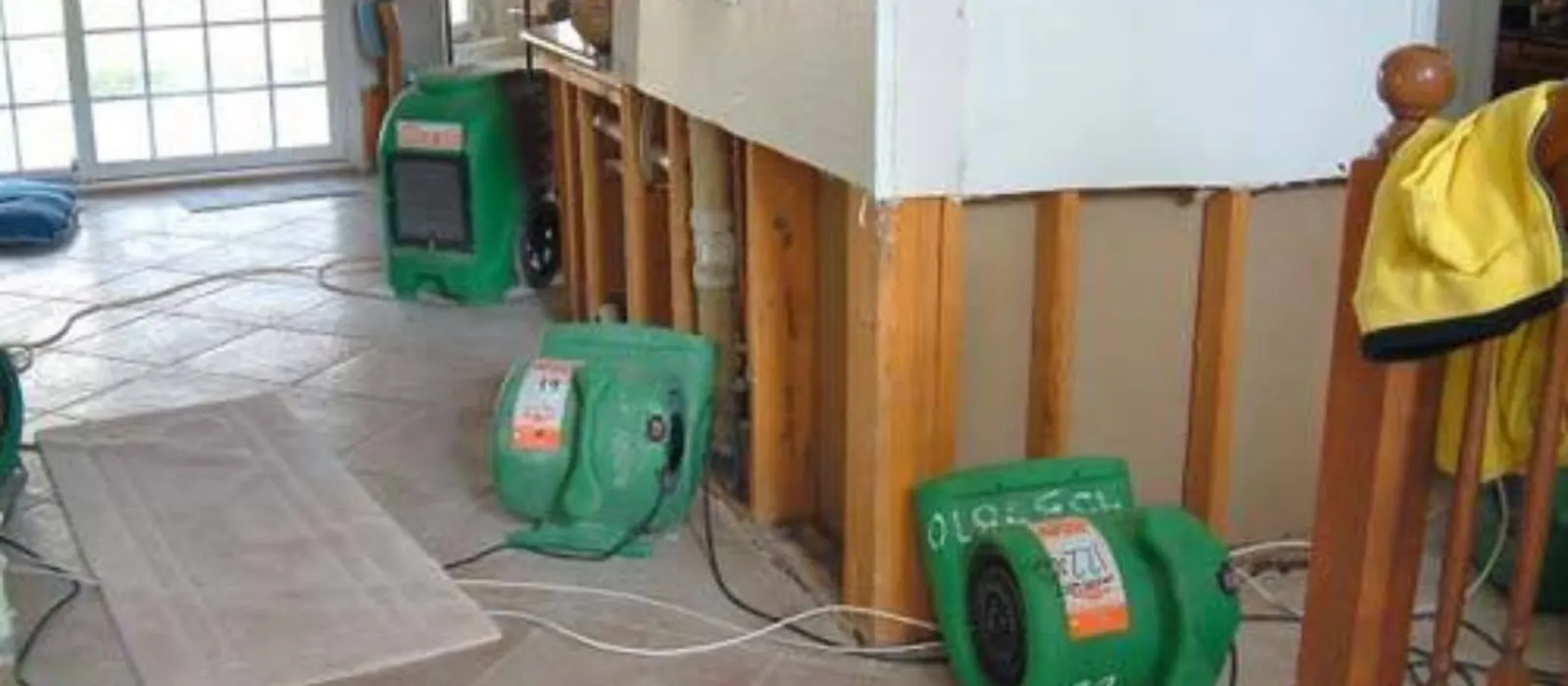
A water mitigation company limits the damage after a leak, burst pipe or flood. The crew finds and stops the source, extracts standing water, removes materials that cannot be saved, and sets air movers and dehumidifiers to dry the rest. Mitigation ends when moisture readings reach a dry standard. Rebuilding walls, floors and paint is a separate job that comes after.
That split matters because the first few days decide how big the rebuild becomes. Wet drywall and carpet pad start to grow mold within roughly 24 to 48 hours, so speed and method count more than a long list of promises. Our water mitigation service follows the sequence below.
The job day by day
| Stage | What the crew does | What you should see |
|---|---|---|
| First visit | Stops or isolates the water source, checks for electrical and sewage risk, extracts standing water | Extraction units running, a written scope, photos taken before anything is moved |
| Same day | Maps wet areas with moisture meters and a thermal imaging camera, removes ruined pad, baseboard or wet drywall | Marked wet zones, debris bagged, contents moved or blocked up |
| Days 1 to 3 | Sets air movers and LGR dehumidifiers, closes the space off from dry rooms | Equipment running around the clock, a daily visit to log readings |
| Final check | Compares readings against dry reference points, removes equipment | Documented numbers for each wet area, not a verbal okay |
Drying usually takes about three to five days for clean-water losses, though thick materials like subfloor or plaster can run longer. If someone tells you the job is done after one visit with no meter readings, ask what they measured.
Equipment on site and what each piece does
- Extraction units pull standing water and soaked carpet moisture. Faster removal means less water wicking up into walls.
- Air movers push air across wet surfaces so moisture leaves the material and enters the air.
- LGR dehumidifiers pull that moisture out of the air so it does not settle on cool surfaces. Without them, air movers just move humidity around.
- Moisture meters read moisture inside drywall, wood and concrete. They are how a crew knows a surface is dry rather than only feeling dry.
- Thermal imaging camera shows cool, wet areas behind walls and ceilings so the crew knows where to open up.
- Containment sheeting and negative air keep wet-area dust and debris from spreading to dry rooms.
Equipment that is placed once and never adjusted is a warning sign. As rooms dry, a good crew moves air movers and reduces units, and the daily log shows it.
The records a good company hands you
Ask for these in writing
- Photos of the damage and affected materials before demolition
- A moisture map or list of readings per room and material
- Daily drying logs with temperature, humidity and equipment counts
- A line-item scope showing what was removed and why
- Final dry readings compared against an unaffected reference spot
- A clear note on which work is mitigation and which is rebuild
These records also help your insurance conversation. Your insurer decides what is covered, but a clear paper trail makes it easier to explain what happened and what was done. Sudden and accidental damage is often covered, and gradual leaks often are not, so check your policy.
Water on the floor right now?
Call (213) 776-0579 any hour. We will talk you through the safe first steps while a crew is arranged.
What mitigation does not include
Mitigation is not repair. Once the structure is dry, someone still has to hang drywall, replace flooring, texture and paint. Some companies do both stages and some do only one, so ask which applies before you sign. If you need the rebuild afterward, our water damage repair team handles that work as a separate scope.
Larger losses, such as a rising flood or a sewer backup, fall under flood damage restoration and carry extra safety steps. Mitigation also does not diagnose why a pipe failed. If the source was a worn supply line or a failed p-trap connection, a plumber fixes it. A mitigation crew will stop and document the leak, not replace your plumbing.
What South Gate homeowners should know before the crew arrives
Your water may come from the City of South Gate or from Golden State Water Company, which lists South Gate and Hollydale in its Central Basin West service area. Check your water bill now for the provider name and its 24-hour number, because a crew will ask who to call if the main line or meter needs attention.
City tap water here is hard, with total hardness of 226.3 mg/L in the City's 2021 Consumer Confidence Report. Mineral scale can stiffen an old shutoff valve until it will not turn. Test the valve once while nothing is wrong, so the first time you use it is not during a flood.
How to compare two mitigation bids
| Look at | A good sign | A reason to ask more |
|---|---|---|
| Scope | Rooms, materials and equipment listed | One lump number with no detail |
| Drying plan | Equipment counts and an expected number of days | No plan, or only a promise to dry it |
| Monitoring | Daily readings logged | No return visits scheduled |
| Standards | Crews work to ANSI/IICRC S500 | Cannot say what standard they follow |
| Rebuild | Mitigation and rebuild priced separately | Rebuild bundled in before drying is measured |
Price depends on the water category, the area affected, the materials involved, how many drying days and pieces of equipment the job needs, and how much rebuild follows. A company that quotes a fixed figure over the phone without seeing the space is guessing.
Questions to ask before you sign
- Do your crews work to the ANSI/IICRC S500 standard for professional water damage restoration?
- What licenses do you hold? (Look them up on the California Contractors State License Board website.)
- Who stays responsible for the job once equipment is running, and how often will someone read the meters?
- What will you remove, and how will I see that those materials could not be dried?
- How do you separate mitigation costs from rebuild costs on the invoice?
- What happens if readings are still high on the day you planned to leave?
A confident company answers these without hesitating. For emergency jobs, emergency water removal is usually the first step, and the other questions can be answered at the kitchen table while the extraction unit runs.
Red flags worth walking away from
Property owners in Huntington Park and the rest of the area hear the same pitches. Be careful with anyone who demands full payment before work starts, refuses to show their license, or tears out far more than the wet zone without showing meter readings. Another red flag is a company that promises your insurer will approve everything. Only your insurer decides that.
Watch for a crew that starts demolition without checking for electrical or sewage risk. If the water touched outlets, a panel or a sewer backup, stay out of the area and call the utility or 911 for any electrical or gas danger before you call anyone else. Cut power only if the panel is dry and safe to reach.
Questions South Gate homeowners ask about mitigation
As soon as it is safe. Wet drywall, carpet pad and wood can begin to grow mold within roughly 24 to 48 hours, which is the window the EPA gives for drying or discarding wet materials. If you are reading this with water still on the floor, call now.
Often not, but it depends on the water category and how much noise and equipment your space can handle. Air movers and dehumidifiers are loud and run around the clock. Sewage or large losses may mean staying elsewhere for a few days.
No. Mitigation covers stopping the water, removal and drying. Rebuilding finishes comes later. Your policy determines what your insurer pays for each part, so ask your insurer before work begins.
Mitigation is the emergency stage that limits damage. Restoration is the whole process, which includes mitigation, drying to standard, and rebuilding to return the space to its prior condition.
Possibly. The South Gate Building and Safety Division at 8650 California Avenue, (323) 563-9549, says permits are typically required for repair, alteration and construction, including plumbing, mechanical and electrical work. Call them before the rebuild starts so the schedule has no surprise.