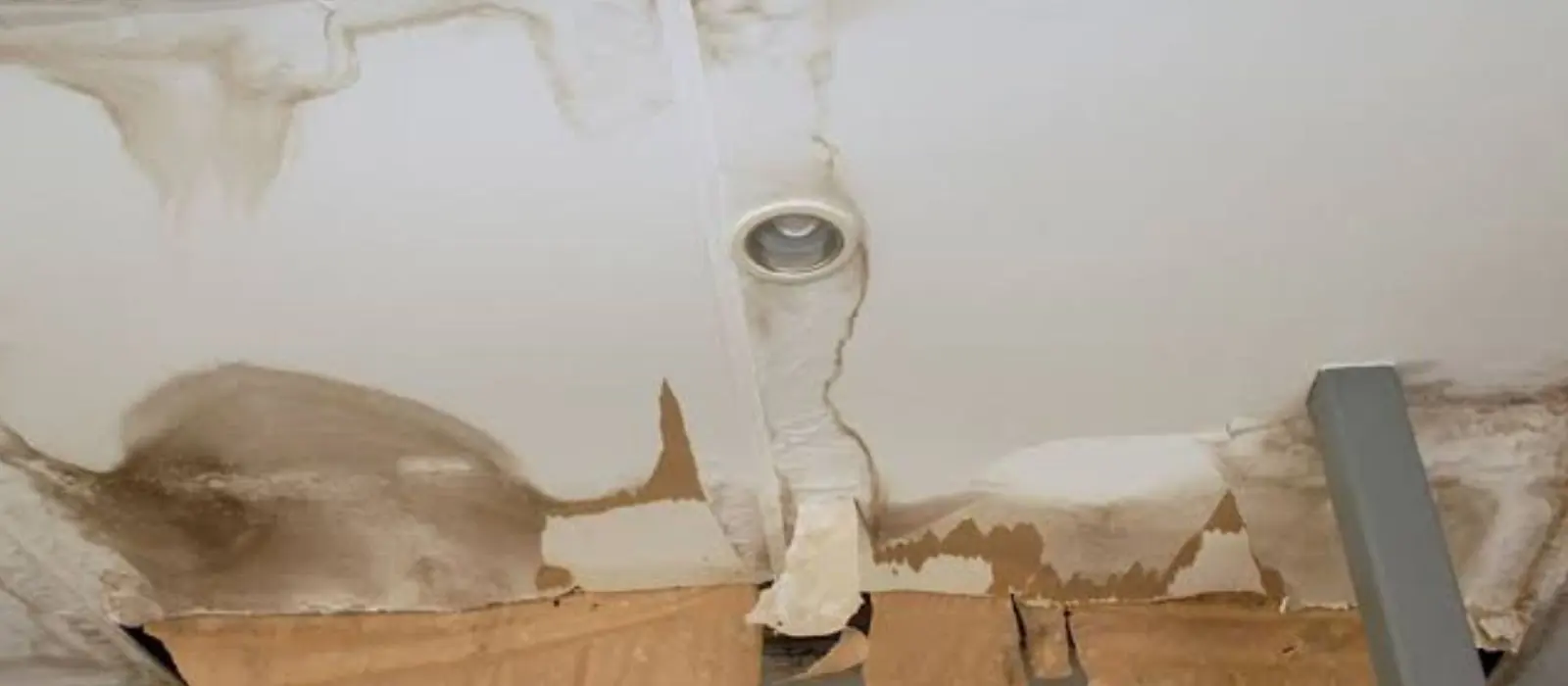
A ceiling tells you a lot about the water above it. A dry brown ring usually means an old leak that stopped. A damp, spreading stain means water is still arriving. A bubble or sag means the drywall is holding water right now. The source is almost always one of three things: a plumbing line, the roof, or the air conditioning system.
What each ceiling sign tells you
| Sign | What it suggests | Urgency |
|---|---|---|
| Faint tan or yellow ring, dry | Past leak that has stopped or a slow, intermittent one | Low, but find the source |
| Dark brown stain with a defined edge | Repeated wetting over time | Moderate |
| Damp or darkening stain | Active water | High, act today |
| Bubble or blister in paint | Water trapped behind the paint film | High |
| Sag or bulge | Drywall saturated and heavy | Emergency, stay clear |
| Peeling paint along a seam | Moisture or humidity at a joint | Moderate |
| Drip from a fixture | Water in a wiring path | Emergency, see safety note |
If water is near wiring
Do not touch a fixture that is dripping or switch it on. Cut power at the breaker only if the panel is dry and you can reach it safely. If you cannot, leave the room and call the utility or 911 before you call us.
Plumbing, roof or HVAC: how to tell
Where the stain sits and when it grows are the best clues. Plumbing leaks tend to appear below a bathroom, kitchen or laundry on an upper floor, and they grow whether it rains or not. Roof leaks track the weather and usually show up on top-floor ceilings, often some distance from where the roof is actually breached because water runs along rafters.
HVAC leaks follow the system. If the stain grows on hot, humid days or appears near an air handler, a clogged condensate line or a sweating duct is the likely cause. A drain pan overflow can soak a ceiling in an afternoon.
- Plumbing: grows after showers, dishwasher cycles or laundry. Look for a failed supply line, a bad shower pan, or a leaking p-trap above.
- Roof: grows after rain, not after fixtures run. Look for damaged flashing, missing shingles or a vent boot that has cracked.
- HVAC: grows on cooling days. Look for a clogged condensate line, a full drain pan or poorly insulated ducts in the attic.
- Condensation: shows up in bathrooms with weak fans and in cold-surface corners, usually with a light, mottled pattern.
A careful way to look for the source
- Mark the edge of the stain with a pencil and write the date next to it.
- Note what happened in the last day: rain, showers, laundry, air conditioner running.
- Check the room above for wet floors, soft caulk, a running toilet or a stained cabinet base.
- Run one fixture at a time and watch the ceiling for a change over ten or fifteen minutes.
- From a stable ladder, look in the attic if there is safe access and no insulation to step through. Do not walk on ceiling joists you cannot see.
- Re-mark the edge the next day. A line that moved is an active leak.
Found a growing stain?
Call (213) 776-0579. We can help you decide whether this is a drying job or a repair.
When to stop investigating and call
Call a professional if you notice any of these
- The ceiling is sagging, bulging or has a hole where water has come through
- Water is dripping from a light fixture, fan or smoke detector
- The stain is more than a couple of feet across or spreading by the hour
- You cannot find the source after checking the room above
- The ceiling is textured or painted in an older home and you plan to scrape it
- There is a musty smell, even if the surface looks dry
Stopping is not giving up. Opening a wet ceiling the wrong way can bring down insulation and water together, and it can spread dust and debris through the house. A short call to describe what you see takes minutes and often saves a day of guessing.
Myths about ceiling water stains
- Myth: If it is dry, the damage is over. Fact: Dry drywall can still sit above wet insulation or framing. A moisture meter is the only way to know.
- Myth: Paint will fix it. Fact: Paint without a stain-blocking primer lets the ring show again, and paint over damp board bubbles.
- Myth: The leak is right above the stain. Fact: Water follows joists and pipes, so the entry point can be several feet away.
- Myth: A small stain means a small problem. Fact: Insulation and framing can be soaked well beyond the visible mark.
What a professional adds
A pro brings tools that show what your eyes cannot: a thermal imaging camera to spot cooler wet zones, pin and pinless moisture meters to map the area, and a borescope to look inside a cavity without cutting. That mapping decides how much ceiling has to come out and how much can stay.
If water is still moving, the first job is emergency water removal, followed by drying the cavity with air movers and a dehumidifier under a water mitigation plan. Once readings are normal, the ceiling is rebuilt under water damage repair. Plumbers and roofers still fix the source, so expect to coordinate.
Dark spots with a musty smell are a separate question. Mold needs moisture, color does not identify what it is, and removal follows the S520 standard, so see our mold remediation page rather than scrubbing it yourself.
South Gate details that affect a ceiling leak
Ceiling leaks in South Gate buildings
Many South Gate homes were built or expanded between about 1910 and 1940, and some were owner-built. In an older house, the pipes above your ceiling may be older supply and drain lines, and the ceiling itself may be plaster over lath. Tell the crew the age of the house and ask about testing materials before demolition, because that shapes how the ceiling is opened.
Repair work that touches plumbing, electrical or structure may need permits. South Gate Building and Safety, at 8650 California Avenue and (323) 563-9549, can tell you what applies before the work begins.
Questions South Gate homeowners ask about ceiling water damage
Drywall begins to soften within hours of staying wet, and mold needs moisture to grow. The EPA advises drying or discarding wet materials within 24 to 48 hours, so a stain that is still growing deserves quick attention.
It usually means water reached the ceiling at some point. It can be old and finished. Mark it, re-check it after rain and after fixtures run, and have the area metered if you are unsure.
That points to the roof, a vent boot or flashing. Water often runs along rafters before it drips, so the stain can be offset from the actual opening.
Possibly, but confirm it is dry with a meter, find out why it appeared, and seal it with a stain-blocking primer. A stain that has stopped may start again with the next leak.
Sudden and accidental damage is often covered. Gradual leaks and neglected maintenance often are not. Read your policy, ask your insurer, and photograph the damage before repairs.
Yes. We work in Compton, where the streets are mostly single-family homes, and in Downey, where postwar suburban housing is common. In both, an attic leak above a single-story house can run for days before a stain shows.
If you can safely get into the attic, a flashlight look at the underside of the roof deck after rain is a useful first check.