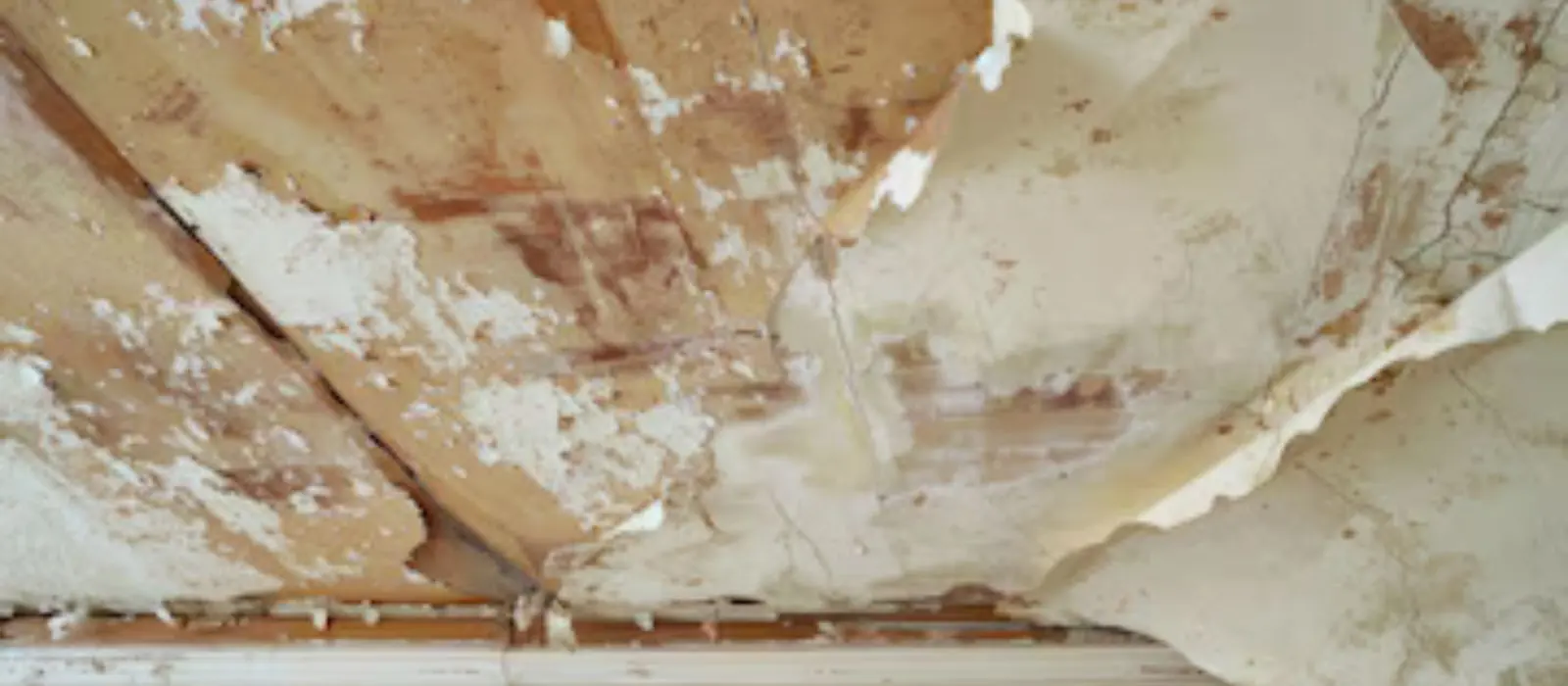
You can repair a small, dry, stained patch of ceiling yourself in a weekend. You should not repair a ceiling that is sagging, still dripping, damp to the touch, or sitting under a light fixture or fan that got wet. The first case is cosmetic. The second is a water damage problem, and paint over it only hides drywall that keeps soaking up moisture.
Patch it yourself or stop and call
| What you see | What it usually means | Your move |
|---|---|---|
| Brown ring, surface dry, no sag | An old leak that has stopped | DIY patch after you confirm the source is fixed |
| Stain that grows after rain or after a shower | A live leak from the roof, a supply line or a drain | Find and fix the source first, then re-check |
| Bubble, bulge or sag | Drywall holding water | Stay out from underneath. Call a pro |
| Drip from a light fixture or fan | Water inside the electrical box | Do not touch it. Follow the safety box below |
| Stain larger than a few feet across | Wet insulation and framing above | Call for moisture mapping before any repair |
| Musty smell or dark spots | Moisture has been there a while | Stop. Treat it as a possible mold remediation question |
Safety before you touch the ceiling
Water plus wiring is an emergency
If water is coming through a light fixture, a fan or an outlet, stay out of the room. Cut power at the breaker only if the panel is dry and you can reach it without stepping through water. If you cannot, call the utility or 911 before you call us.
A sagging ceiling can drop without warning, and the water in it is heavy. Do not stand, work or let anyone sit under a bulge.
If the ceiling is stable and dry, wear safety glasses, a dust mask and gloves, because drywall dust gets into everything. Use a sturdy ladder on a dry floor.
Fix the source, then confirm it is dry
A ceiling stain is a symptom. Before any patch, find out where the water came from: a failed supply line or p-trap in the bathroom above, a leaking water heater, a condensate line from an air handler, or a roof leak. A plumber or roofer fixes that part. Painting first just buys you the same stain next month.
Then prove the area is dry. A pin-type moisture meter reads wood and drywall, and a reading near the dry reference on the dial is what you want. No meter? Run a fan and a dehumidifier for several days and press the area. If it still feels cool or soft, it is still wet.
Repair steps for a small stained patch
- Clear the room and cover the floor with plastic sheeting and a drop cloth.
- Scrape away loose paint and peeling texture with a putty knife.
- Press the drywall. If it is soft, crumbles or has lifted tape, cut that section out back to solid drywall with a drywall saw, ideally to the nearest joist.
- Screw a scrap backer board or a new piece of drywall into place and tape the seams.
- Spread joint compound in thin coats, letting each coat dry fully. Feather the edges wide so the patch disappears.
- Sand lightly with a pole sander, wiping dust between coats.
- Seal the area with a stain-blocking primer, oil-based or shellac-based. Ordinary wall paint lets brown tannin stains bleed back through.
- Match the texture if the ceiling has one, then finish with two coats of ceiling paint.
Tools and materials to have ready
Repair kit checklist
- Moisture meter or a way to keep a fan running for several days
- Drywall saw, utility knife and putty knife in two widths
- Drywall screws, mesh or paper tape, joint compound
- Pole sander and fine sanding screens
- Stain-blocking primer and ceiling paint
- Safety glasses, dust mask, gloves, stable ladder
- Plastic sheeting, drop cloths and a shop vacuum
Not sure the ceiling is dry or safe?
Call (213) 776-0579 and tell us what you see. We will say whether it is a patch or a drying job.
Mistakes that bring the stain back
- Painting over a damp ceiling. Trapped moisture lifts the paint and feeds mold.
- Skipping the primer. Standard paint lets the brown ring show through within days.
- Patching soft drywall. Compound over crumbling board cracks and peels.
- Ignoring the insulation. Wet insulation above the drywall stays wet for weeks and keeps the ceiling damp from the top.
- Scraping old texture without checking. Textured ceilings and paint in older homes may contain materials that call for testing before you sand or scrape.
When the damage spreads past one patch, the job turns into drying and rebuilding. Our water damage repair work covers cutting out wet board, drying the cavity and rebuilding the ceiling so it matches.
What South Gate's older homes mean for ceiling repairs
Ceiling repairs in older South Gate houses
Most South Gate farmland became homes and factories between about 1910 and 1940, and many early houses were owner-built. If yours is one of them, the ceiling may be plaster over lath instead of drywall, and the paint layers may be old. Tell any contractor the age of the house and ask about testing materials before demolition, because that changes how the ceiling can be opened.
Repairs that touch plumbing, electrical or structure may need permits. South Gate Building and Safety, at 8650 California Avenue and (323) 563-9549, says permits are typically required for home improvement, repair and alteration, so ask before a wall or ceiling is opened.
If you live in a nearby town the same logic applies. About half of Downey's roughly 36,000 housing units are rentals, so a ceiling leak there often starts in the unit above. Tell the landlord in writing and photograph the damage before anything is moved. Crews also cover Downey and Lynwood, so a call from either town gets the same scoping questions.
Questions South Gate homeowners ask about ceiling repair
Only after the source is fixed, the area is fully dry and you have sealed the stain with a stain-blocking primer. Plain paint over a wet or unsealed stain fails quickly and can hide ongoing damage.
Press it with a flat hand. If it is soft, crumbly, bowed or has lifted tape, it has lost strength and should be cut out. Firm, dry drywall with only a stain can usually be sealed and painted.
That is a professional call. Water can pour out suddenly, and wiring or a fixture may be above it. Stay out from underneath and phone for emergency water removal help instead of drilling into it yourself.
Wait until a moisture meter reads dry or the area has felt dry and firm for several days with air moving. Rushing the patch is the most common reason a stain returns. If the wait drags on, water mitigation with air movers and a dehumidifier shortens it considerably.
Sudden and accidental damage, like a burst supply line, is often covered. Slow leaks and neglected maintenance often are not. Read your policy and ask your insurer before repairs begin, and keep photos of the damage.
It matters for the shutoff. Some addresses are served by the City of South Gate and others by Golden State Water Company, which lists a 24-hour line at 1-800-999-4033. Your water bill shows your provider and its emergency number.
If a supply line above the ceiling is still running and your own shutoff valve will not turn, that number is how you stop the water. Hard local water can stiffen old valves, so test yours before an emergency.